Exam Logistics
Friday, April 10, 2026
9:30 AM -- 12:00 PM (2.5 hours)
WB 116 -- 116 students (ABO, ROS-ROY, ANI)
WB 130 -- 61 students (SAK, EVA-ZOR, BEL)
Crowdmark exam, 13 questions, 55 points total
4 questions have multi-parts, 1 longer response
No aids permitted
Grading is strict. Less than 3 minutes per point. If asked for ONE answer, they mark only the first ONE. Circle or highlight your preferred answer. Readings and Guest Lectures are fair game. Cumulative but focused on post-midterm content.
Table of Contents
Course Framework Overview
The entire MIE359 course is organized around one central framework: a causal chain connecting Influences to Organization Design Choices to Outcomes. Every topic in the course fits somewhere within this chain. Understanding where each concept sits in the framework is essential for the exam.
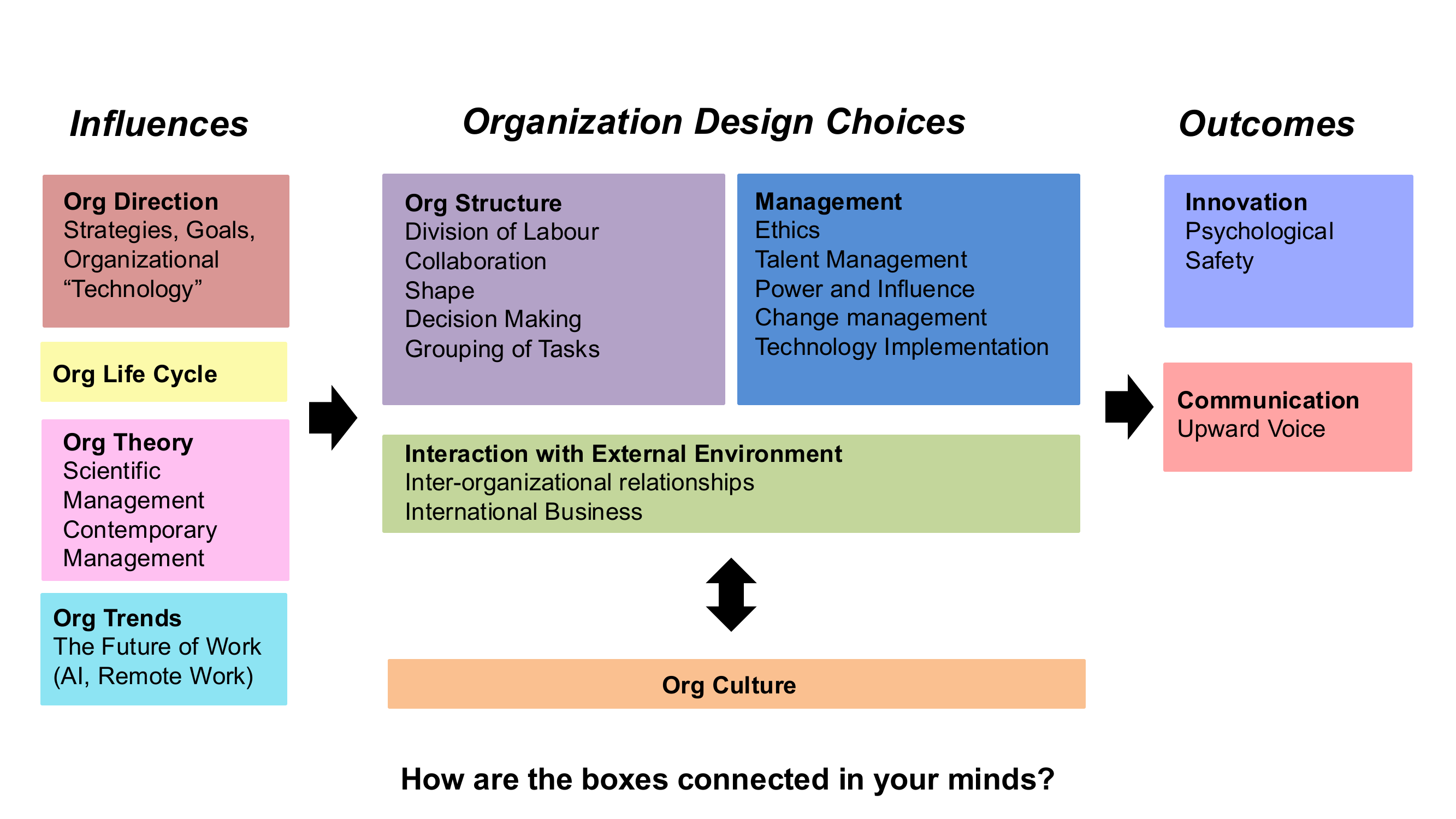
The Three Pillars
1. Influences -- External and internal factors that shape what an organization should look like. These include the environment, technology, size and life cycle stage, goals and strategy, and culture. These are the "inputs" to the design process.
2. Organization Design Choices -- The structural decisions managers make in response to those influences. The five design variables (division of labour, collaboration mechanisms, shape, decision-making centralization, and grouping of tasks) are the levers managers can pull.
3. Outcomes -- The results of those design choices, including effectiveness, efficiency, innovation capability, employee satisfaction, and organizational survival. Good design aligns structure with context.
Fit is everything. There is no single "best" organizational design. The right design depends on the alignment between influences and choices. A structure that works for a startup will fail in a mature bureaucracy, and vice versa.
Organization Theory
Organization theory provides the intellectual foundations for how we think about structuring work. The course contrasts two broad eras of thinking: Classical Management and Contemporary Management. Each reflects the dominant challenges and assumptions of its time.
The Machine Model
- Efficiency as the paramount goal
- Hierarchy and clear chains of command
- Bureaucracy -- rules, procedures, standardization
- The "one best way" to organize (Taylor, Weber, Fayol)
- Workers as interchangeable parts
- Centralized decision making
- Emphasis on formal structure over informal relationships
The Living System
- Decentralized decision making
- Collaboration and teamwork emphasis
- Information sharing across boundaries
- Adaptability and continuous change
- Learning organizations -- knowledge as key asset
- Workers as creative contributors
- Flat structures, empowered teams
Neither approach is inherently "better." Classical management still works in stable, predictable environments. Contemporary management excels in dynamic, uncertain contexts. The exam may ask you to evaluate which approach fits a given scenario.
The 5 Design Variables
These are the five fundamental structural levers that managers use to shape an organization. Every organizational design question ultimately comes down to choices across these five dimensions. They interact with each other -- changing one often requires adjusting others.
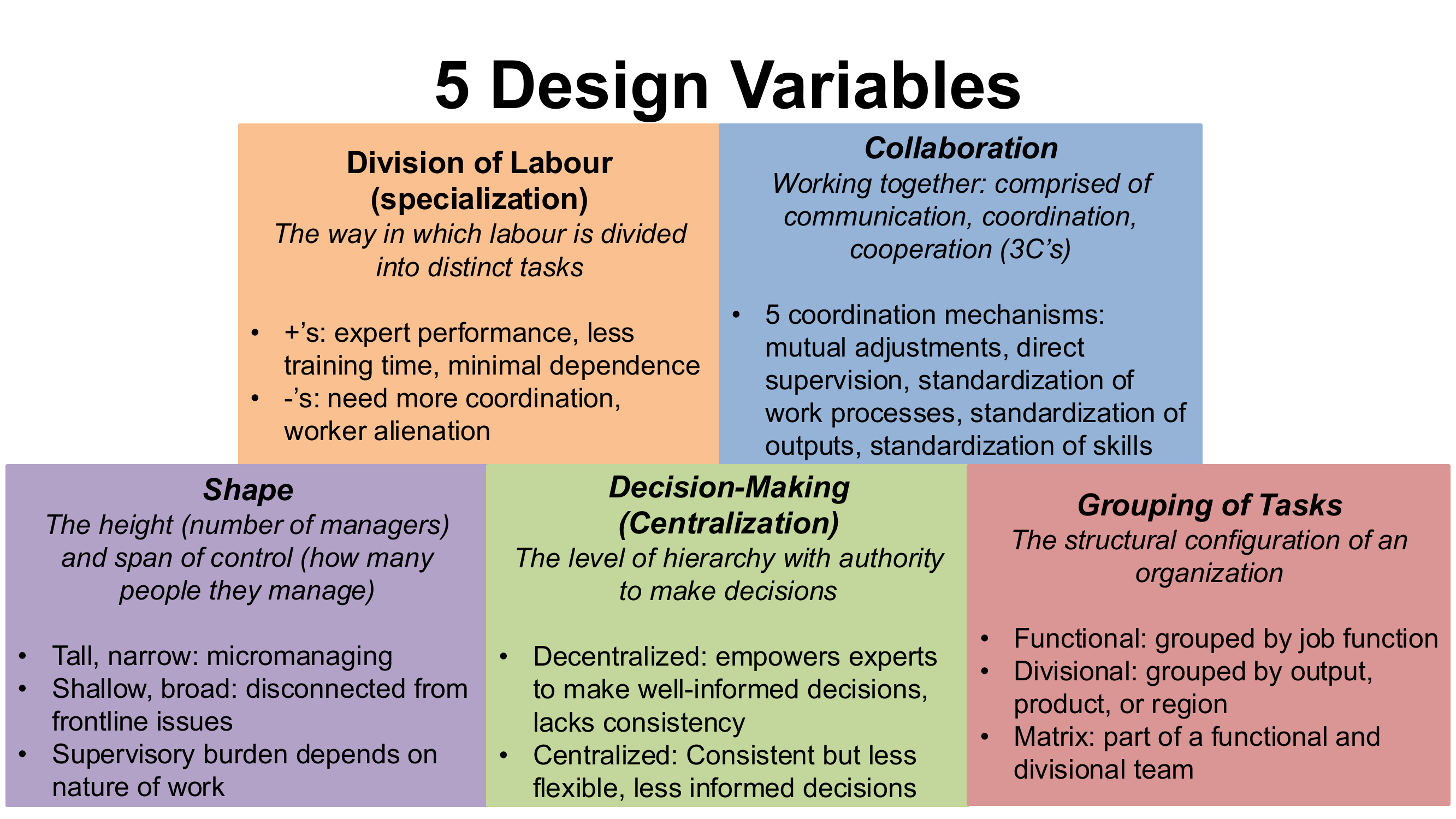
Division of Labour (Specialization)
How work is broken down into specialized tasks. Higher specialization means each person does a narrower set of tasks.
- Expert performance from focused practice
- Less training time required per worker
- Minimal dependence between workers
- Easier to replace individual workers
- More coordination needed across specialists
- Worker alienation and boredom
- Loss of "big picture" understanding
- Reduced flexibility when tasks change
Collaboration
The mechanisms that hold the organization together. Collaboration involves the 3C's and five coordination mechanisms.
Communication -- sharing information | Coordination -- aligning activities | Cooperation -- working toward shared goals
| Mechanism | Description | Best For |
|---|---|---|
| Mutual Adjustment | Informal communication between workers | Small teams, complex/novel work |
| Direct Supervision | One person takes responsibility for others' work | Larger groups, clear hierarchy |
| Standardization of Work Processes | Specifying how work must be done | Routine, predictable tasks |
| Standardization of Outputs | Specifying what results must be achieved | Results-oriented contexts |
| Standardization of Skills | Specifying the training/qualifications needed | Professional work (e.g. hospitals) |
Shape
Shape is defined by two interrelated dimensions: height (number of hierarchical levels / number of managers) and span of control (how many direct reports each manager has).
Many layers, small spans. Risk: micromanaging, slow decision flow, information distortion through many levels.
Few layers, large spans. Risk: managers disconnected from frontline, overwhelmed, unable to provide adequate supervision.
Decision Making (Centralization)
Where decisions are made in the hierarchy -- at the top (centralized) or pushed down to the people closest to the work (decentralized).
Consistent decisions, unified direction, easier to control. But: less flexible, slower response, disempowers lower-level employees.
Empowers experts closest to the problem, faster response. But: lacks consistency, harder to coordinate across the org.
Grouping of Tasks
How jobs are clustered into departments, units, and divisions. The three primary approaches:
| Structure | Grouped By | Strengths | Weaknesses |
|---|---|---|---|
| Functional | Job function (HR, Marketing, Engineering) | Deep expertise, efficiency, economies of scale | Silos, poor cross-functional coordination |
| Divisional | Output, product, region, or customer | Responsive to specific markets, accountability | Duplication of resources, less knowledge sharing |
| Matrix | Both function AND division | Dual focus, flexibility, information sharing | Dual authority confusion, conflict, slower decisions |
Goals & Strategy
Goals give organizations direction, and strategy provides the roadmap. The distinction between high-level goals and operative goals is fundamental. Strategy frameworks like Miles & Snow and Porter's Generic Strategies provide frameworks for classifying how organizations compete.
Goal Hierarchy
Mission -- the organization's reason for existing. Vision -- an aspirational picture of the future. These are directional but not actionable on their own.
Specific, actionable objectives that guide day-to-day operations. Many types: performance, resource, market, employee development, innovation, productivity goals.
Goal Conflict -- when pursuing one goal makes it harder to achieve another (e.g., cost reduction vs. quality improvement). Goal Displacement -- when the means to achieve goals becomes the goal itself (e.g., following rules becomes more important than the original purpose of those rules).
Strategy Frameworks
| Type | Strategy | Structure Implications |
|---|---|---|
| Prospector | Innovation, first mover, seeks new markets | Flexible, decentralized, organic |
| Defender | Protects current market share, efficiency focus | Centralized, mechanistic, tight controls |
| Analyzer | Balances stability with selective innovation | Hybrid structure, moderate centralization |
| Reactor | No consistent strategy, responds to environment | Inconsistent structure, often performing poorly |
| Strategy | Focus | Scope |
|---|---|---|
| Low Cost Leadership | Be the cheapest producer | Broad market |
| Differentiation | Unique product/service valued by customers | Broad market |
| Focused Low Cost | Cheapest in a specific niche | Narrow market |
| Focused Differentiation | Unique offering in a specific niche | Narrow market |
Organizational Technology
Technology, in the organizational design sense, refers to how an organization transforms inputs into outputs -- not just IT systems, but the entire production process. The type of technology an organization uses has profound implications for its optimal structure.
Core vs. Non-Core Technology
Core technology is directly related to the organization's mission and primary product or service. It determines the fundamental structure. Non-core technology supports the mission but is not the central transformation process.
Key distinction: Product organizations (tangible outputs, standardizable) vs. Service organizations (intangible, customer interaction, harder to standardize).
Woodward's Categorization of Manufacturing Firms
Joan Woodward's landmark study classified manufacturing firms by production complexity:
| Type | Description | Structure |
|---|---|---|
| Small Batch / Unit | Custom, one-at-a-time production | Organic, flexible, skilled workers |
| Large Batch / Mass | Standardized, assembly line | Mechanistic, formalized, many rules |
| Continuous Process | Automated, ongoing production (e.g., oil refinery) | Organic again, highly skilled, fewer workers |
Non-Core Technology (Perrow's Framework)
Categorized along two dimensions: Task Variability (how many exceptions occur) and Task Analyzability (how easy it is to find solutions when exceptions arise).
| Low Variability | High Variability | |
|---|---|---|
| High Analyzability | Routine (e.g., assembly line) | Engineering (e.g., heavy machinery) |
| Low Analyzability | Craft (e.g., fine glassmaking) | Non-Routine (e.g., strategic planning) |
Organization Life Cycle
Organizations evolve through predictable stages, each with characteristic structural challenges and crises. Understanding where an organization sits in its life cycle is essential for diagnosing structural problems and prescribing appropriate changes.
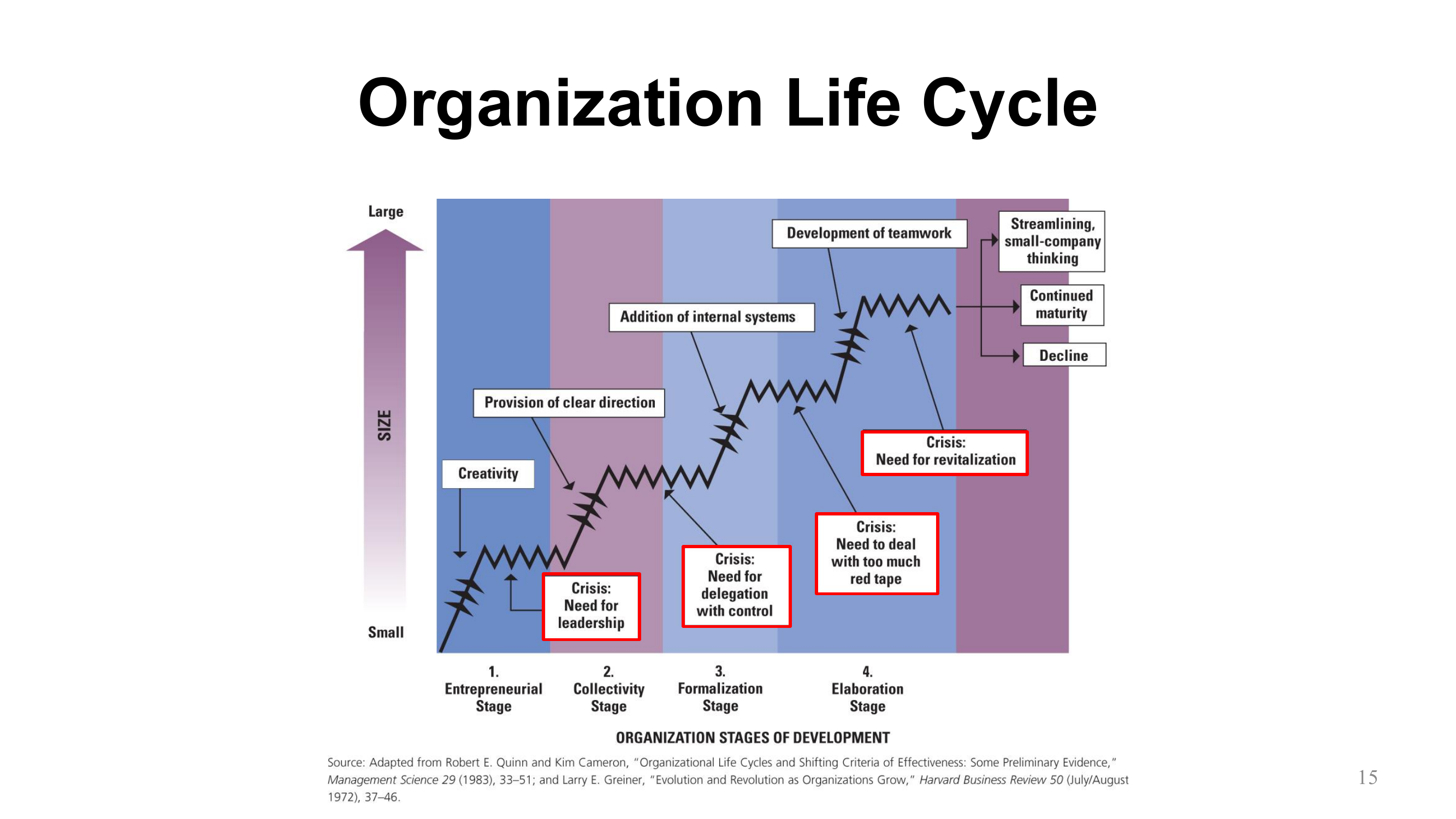
The Four Stages
| Stage | Characteristics | Crisis That Follows |
|---|---|---|
| 1. Entrepreneurial | Creativity, informal, founder-driven, minimal structure | Need for leadership -- founders cannot do everything |
| 2. Collectivity | Strong leadership, mission clarity, informal communication, high commitment | Need for delegation with control -- leaders get overwhelmed |
| 3. Formalization | Rules, procedures, formal systems, efficiency focus, professional management | Need to deal with red tape -- too many rules stifle innovation |
| 4. Elaboration | Decentralization, collaboration, teamwork, adaptability | Need for revitalization -- organizational renewal |
Possible outcomes after Elaboration: (1) Streamlining/small-company thinking -- innovating within the large structure, (2) Continued maturity -- stable but not growing, (3) Decline -- failure to adapt leads to contraction or death.
Bureaucracy
Bureaucracy is often used as a pejorative, but in organizational theory it is a specific structural form with both significant strengths and well-known weaknesses. Weber's model of bureaucracy was designed to replace arbitrary, nepotistic management with rational, rule-based systems.
Defining Features of Bureaucracy
- Rules and procedures -- standard operating procedures govern behavior
- Specialization / Division of labour -- clearly defined roles and responsibilities
- Hierarchy of authority -- clear chain of command with defined reporting relationships
- Impersonal treatment -- rules apply equally to everyone
- Technical competence as basis for hiring and promotion
- Written documentation and records
- Less innovation -- rules constrain creativity
- Less adaptability -- slow to respond to change
- Slower decision making -- everything goes through channels
- Goal displacement -- following rules becomes the goal
- Employee frustration and dehumanization
- Helps marginalized populations be treated fairly -- rules prevent arbitrary discrimination
- Supports HR needs -- clear job descriptions, pay structures, evaluation criteria
- Provides predictability and consistency
- Enables coordination at scale
- Reduces dependence on individual managers
Culture
Organizational culture is the shared set of values, beliefs, assumptions, and norms that shape behavior within an organization. The iceberg model is the key metaphor: what you see on the surface (artifacts) is only a small part of culture. The deeper elements -- values, assumptions, beliefs -- are far more powerful and far harder to change.
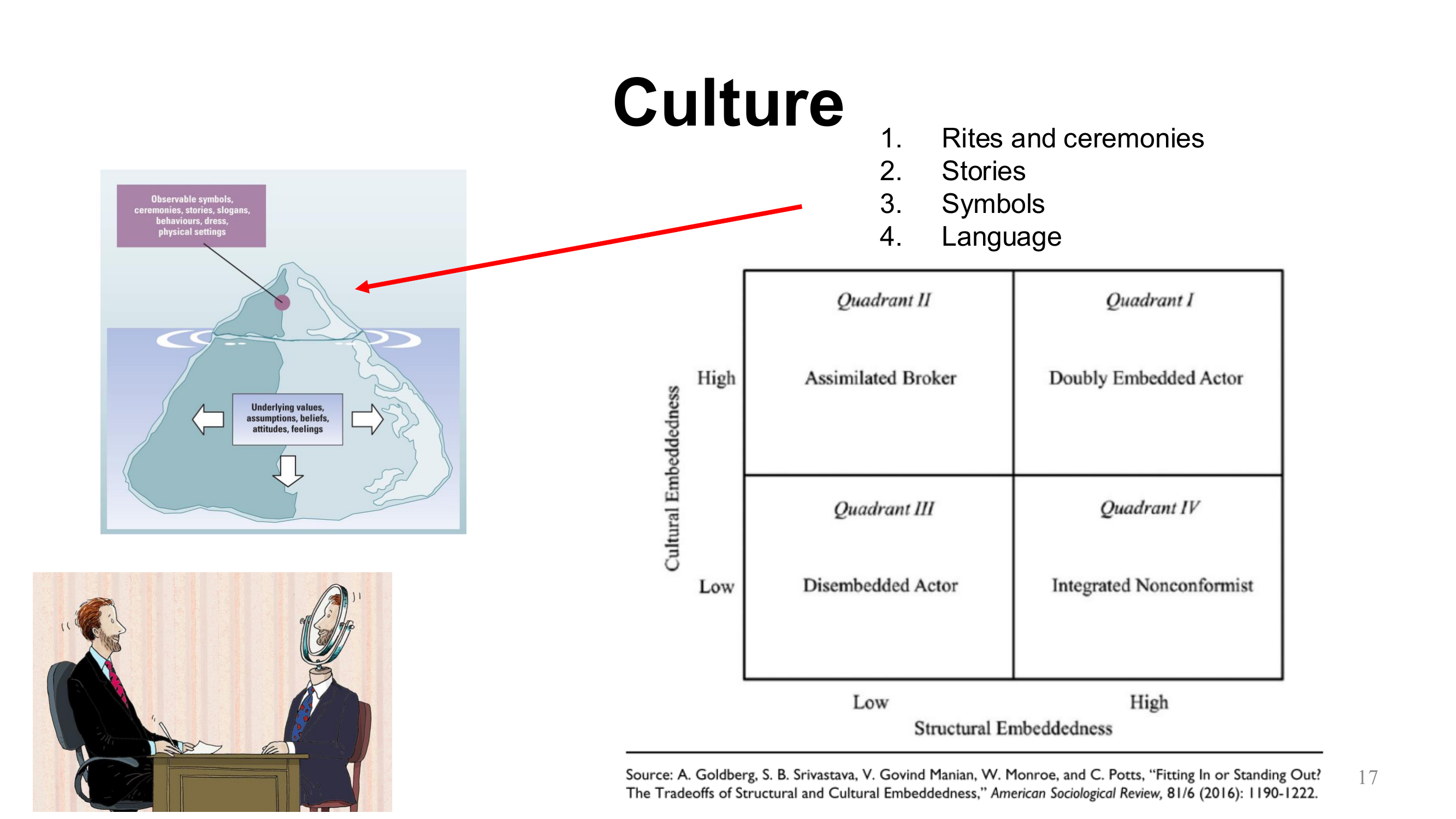
Observable vs. Underlying Culture
- Symbols (logos, office design, dress code)
- Ceremonies and rituals
- Stories and legends
- Slogans and language
- Behaviours and norms
- Physical settings
- Core values
- Unstated assumptions
- Beliefs about human nature
- Attitudes toward authority, risk, conflict
- Deep feelings and emotional patterns
Four Manifestations of Culture
| Manifestation | Description |
|---|---|
| Rites & Ceremonies | Planned activities (onboarding, awards) that reinforce values |
| Stories | Narratives about founders, key events, heroes that transmit values |
| Symbols | Physical artifacts that represent the organization's identity |
| Language | Specific jargon, slogans, and sayings that encode shared meaning |
Embeddedness Quadrants
Embeddedness describes how strongly an individual is connected to the organization's culture and the broader community:
| High Org Embeddedness | Low Org Embeddedness | |
|---|---|---|
| High Community Embeddedness | Q1: Doubly Embedded Actor -- deeply connected to both org and community | Q4: Integrated Nonconformist -- connected to community but not org culture |
| Low Community Embeddedness | Q2: Assimilated Broker -- absorbed into org, disconnected from community | Q3: Disembedded Actor -- disconnected from both org and community |
Interorganizational Relationships
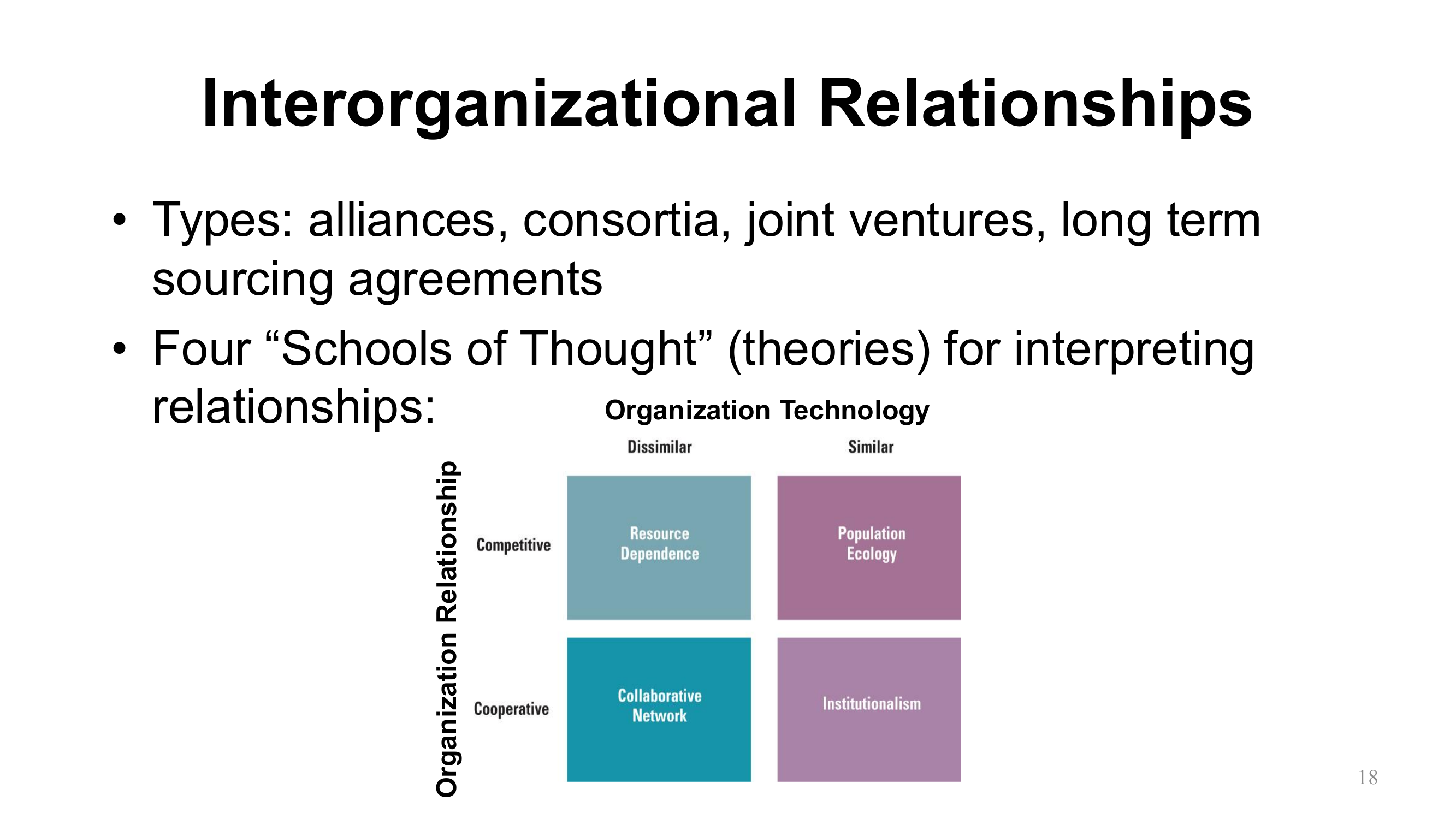
Organizations do not exist in isolation. The relationships between organizations -- whether competitive or cooperative -- shape strategy, structure, and survival. The course presents a 2x2 matrix of four theoretical schools of thought for understanding these relationships.
Types of Interorganizational Relationships
- Alliances -- partnerships for mutual benefit
- Consortia -- groups of organizations pooling resources
- Joint Ventures -- new entity created by two or more organizations
- Long-Term Sourcing Agreements -- stable supplier relationships
Four Schools of Thought
| Dissimilar Organizations | Similar Organizations | |
|---|---|---|
| Competitive Relationship | Resource Dependence -- organizations depend on each other for resources and try to minimize that dependence | Population Ecology -- natural selection determines which organizations survive based on environmental fit |
| Cooperative Relationship | Collaborative Network -- dissimilar organizations cooperate to achieve complementary goals | Institutionalism -- similar organizations copy each other to gain legitimacy (isomorphism) |
Isomorphism (from Institutionalism) -- organizations in the same field become more similar over time through three mechanisms: coercive (regulations), mimetic (copying successful peers), and normative (professional standards).
Innovation
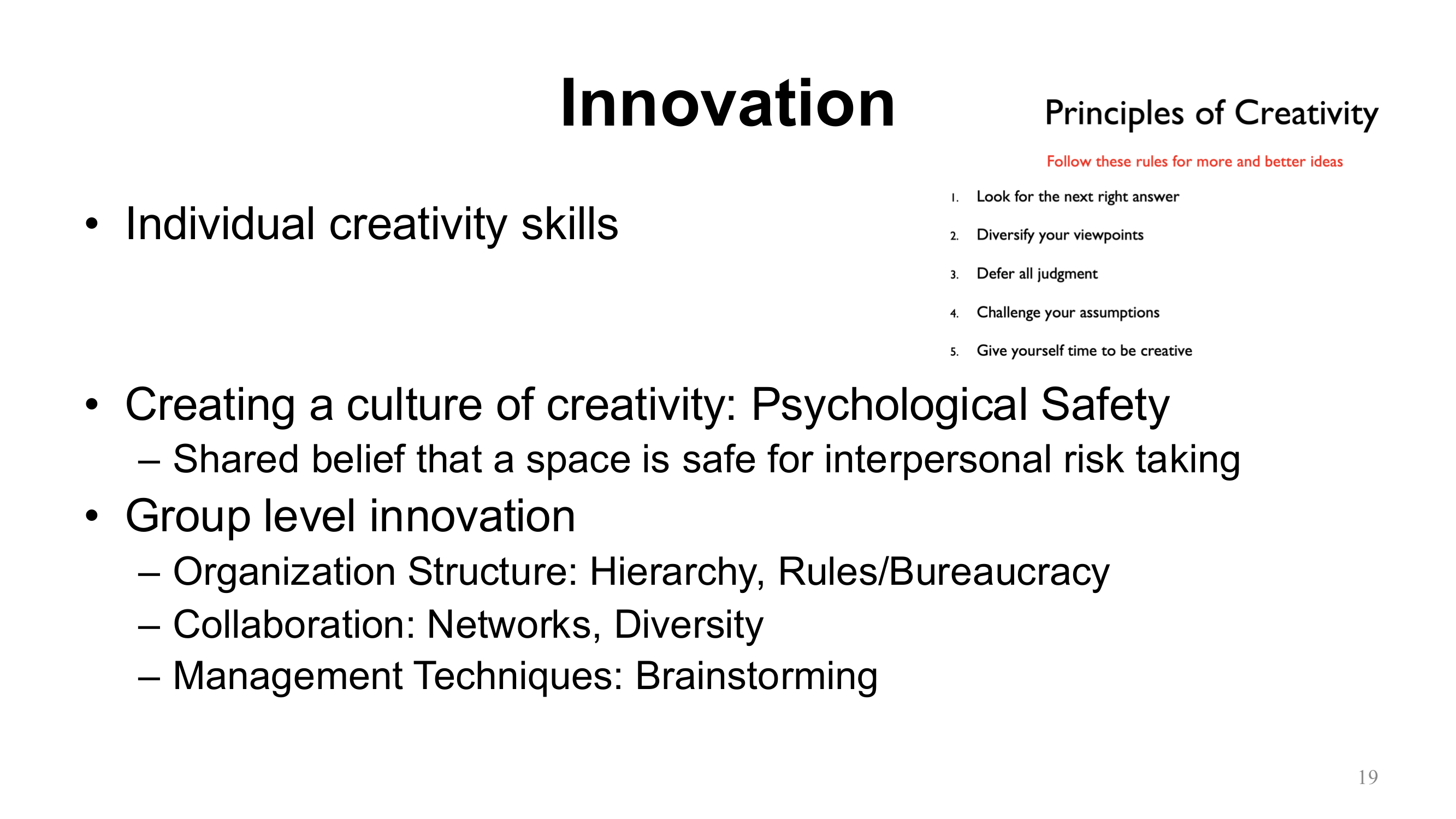
Innovation is the process of turning creative ideas into practical applications. The course examines innovation at three levels: individual creativity, group-level innovation, and organizational structures that support or hinder innovation.
5 Principles of Creativity
- Look for the next right answer -- avoid fixating on the first solution. There are multiple valid approaches to any problem.
- Diversify viewpoints -- bring in perspectives from different disciplines, backgrounds, and experiences.
- Defer judgment -- separate ideation from evaluation. Premature criticism kills ideas before they develop.
- Challenge assumptions -- question "the way things have always been done." Breakthrough ideas often violate conventional wisdom.
- Give yourself time -- creativity requires incubation. Rushed processes produce incremental, not breakthrough, ideas.
Psychological Safety
A shared belief that the space is safe for interpersonal risk taking. Team members feel confident they will not be punished, embarrassed, or rejected for speaking up with ideas, questions, concerns, or mistakes. Essential for innovation because creativity requires vulnerability.
Group-Level Innovation
Three factors drive group innovation:
- Org Structure -- hierarchy and rules can either enable or constrain creative work. Flatter, more organic structures tend to support innovation.
- Collaboration -- networks and diversity of connections. Weak ties bring novel information; strong ties enable execution.
- Management Techniques -- brainstorming methods, design thinking, hackathons, innovation labs.
Change Management
Change management is one of the most heavily tested post-midterm topics. The core insight is that change is hard because humans are wired to resist it -- breaking routines costs cognitive resources. Leaders who understand the psychology of change and use the right network structures can dramatically increase their success rate.
Incremental vs. Radical Change
Small, continuous improvements within existing framework. Lower risk, lower resistance, builds on current systems.
Fundamental transformation of the organization. High risk, high resistance, but sometimes necessary for survival.
Why we resist change: Breaking routines saves cognitive resources. Habits are efficient -- they free up mental capacity for other tasks. Change forces us to re-engage cognitively with things we had automated, which feels effortful and threatening.
Kotter's 8 Reasons Change Efforts Fail (HBR)
These are from the classic Harvard Business Review article. Know all eight and be able to explain each.
- Not Establishing a Great Enough Sense of Urgency -- If people do not feel the burning platform, they will not prioritize change over the status quo.
- Not Creating a Powerful Enough Guiding Coalition -- Change requires a team of influential people who are committed. A lone champion is not enough.
- Lacking a Vision -- Without a clear, compelling picture of the future state, people cannot align their efforts.
- Undercommunicating the Vision by a Factor of Ten -- Leaders consistently underestimate how much repetition is needed. The vision must be communicated through every channel, repeatedly.
- Not Removing Obstacles to the New Vision -- Structural barriers, hostile managers, misaligned incentives, and outdated systems can kill change even when people buy in.
- Not Systematically Planning For and Creating Short-Term Wins -- People need visible evidence that the change is working. Without early wins, momentum dies.
- Declaring Victory Too Soon -- Celebrating early wins can be mistaken for final victory. Change must be anchored before moving on.
- Not Anchoring Changes in the Corporation's Culture -- Until the new behaviors are embedded in "how we do things here," they will regress when pressure is removed.
Networks and Change
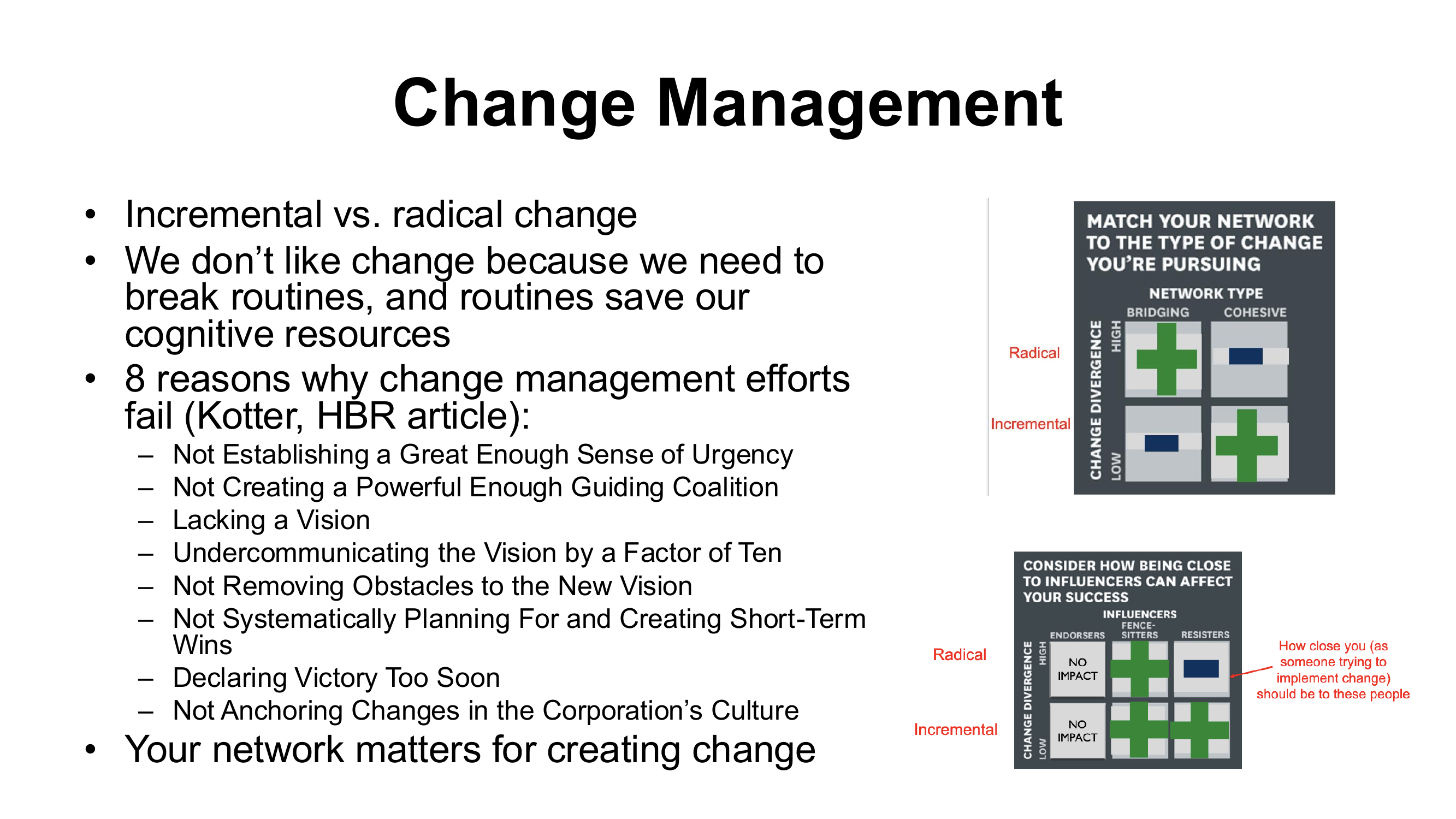
Match the network type to the change type:
| Network Type | Characteristics | Best For |
|---|---|---|
| Bridging (Weak Ties) | Connections across different groups, access to diverse information | Radical change -- novel ideas come from outside your usual circle |
| Cohesive (Strong Ties) | Dense connections within a group, trust, shared norms | Incremental change -- trust enables coordinated, reliable execution |
Power and Influence
Power is the ability to influence the behavior of others. It comes from two main sources -- your position in the organization and your personal attributes. Understanding the distinction between these sources and the three influence strategies is essential for the exam.
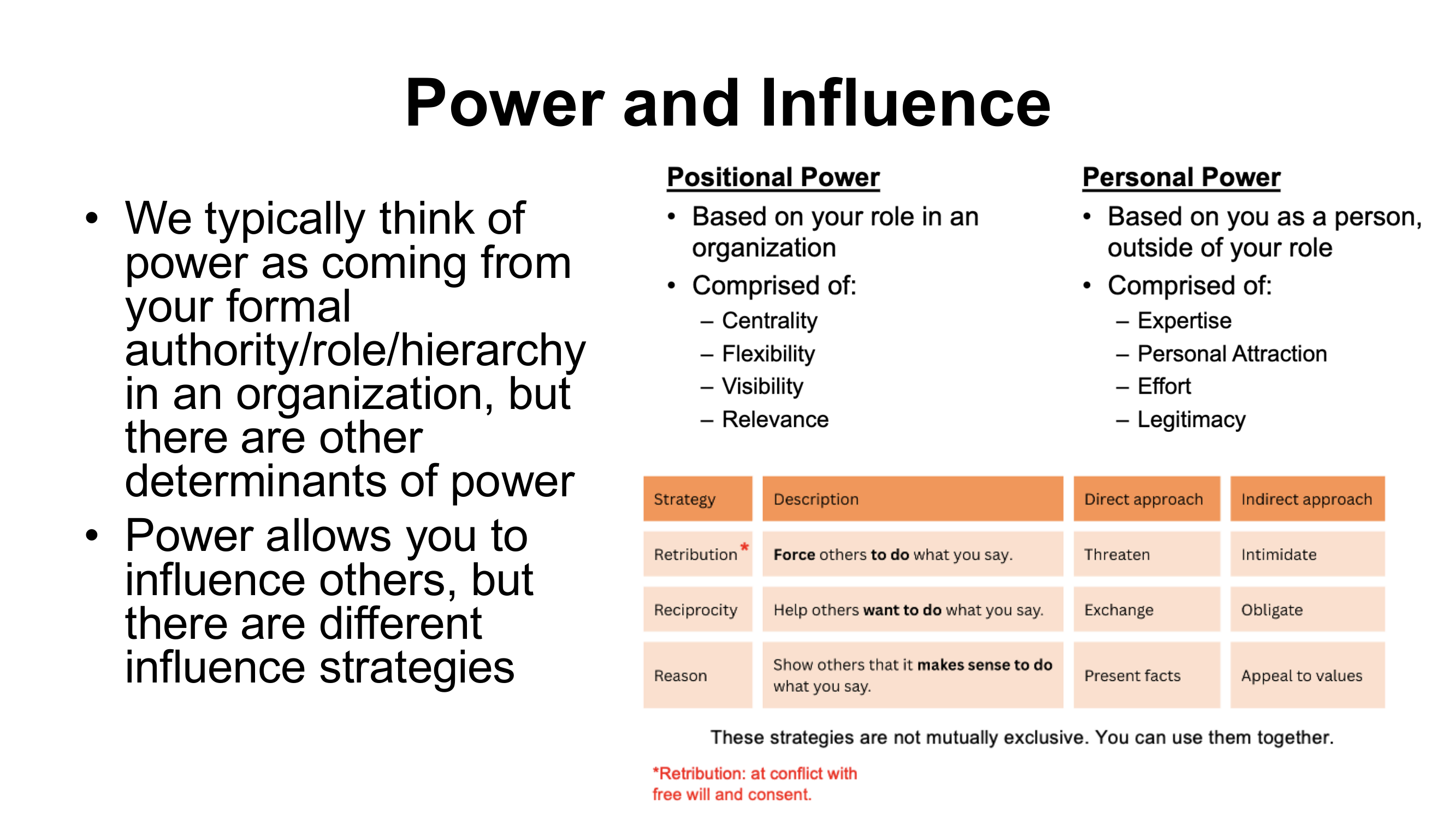
Power derived from your role in the organization:
- Centrality -- being in the middle of information flows and decision processes
- Flexibility -- having discretion in how you perform your role
- Visibility -- being seen by those who matter (leaders, key stakeholders)
- Relevance -- working on tasks that are critical to the organization's success
Power derived from who you are:
- Expertise -- specialized knowledge or skills that others need
- Personal Attraction -- charisma, likability, and interpersonal appeal
- Effort -- demonstrating commitment and hard work beyond expectations
- Legitimacy -- behaving in ways consistent with organizational values and norms
Three Influence Strategies
These are not mutually exclusive -- effective leaders often combine them.
| Strategy | Direct Form | Indirect Form | Notes |
|---|---|---|---|
| Retribution | Threaten -- "do this or else" | Intimidate -- create an atmosphere of fear | Conflicts with free will. Use only when necessary and with caution. |
| Reciprocity | Exchange -- "I'll do X if you do Y" | Obligate -- do favors to create a sense of debt | Gets others to want to do what you say. Based on social exchange. |
| Reason | Present facts -- logical argument with evidence | Appeal to values -- connect to shared principles | Show it makes sense. Most sustainable long-term strategy. |
The Psychology of Work
Guest Lecture -- Dr. Tanberg
This guest lecture explored the hidden psychological infrastructure of organizations. Groups are not just collections of individuals -- they have their own dynamics, memory systems, and identity processes that profoundly shape organizational outcomes.
Key Concepts
How you structure a brainstorming session determines what ideas emerge. Format, rules, group composition, and facilitation technique all matter more than most people realize.
Gossip serves organizational functions -- it transmits norms, enforces social control, and shares information about trustworthiness. Social Identity Theory -- people define themselves partly through group membership, which creates in-group/out-group dynamics.
A group-level cognitive system where team members know who knows what. Rather than each person knowing everything, the team distributes knowledge across members and knows how to access it. TMS develops through working together over time and makes teams more efficient.
High performing teams use metacognition -- they think about their own thinking processes. They reflect on how they work together, identify process improvements, and adapt their collaboration strategies. This "thinking about thinking" distinguishes the best teams.
Virtual Work
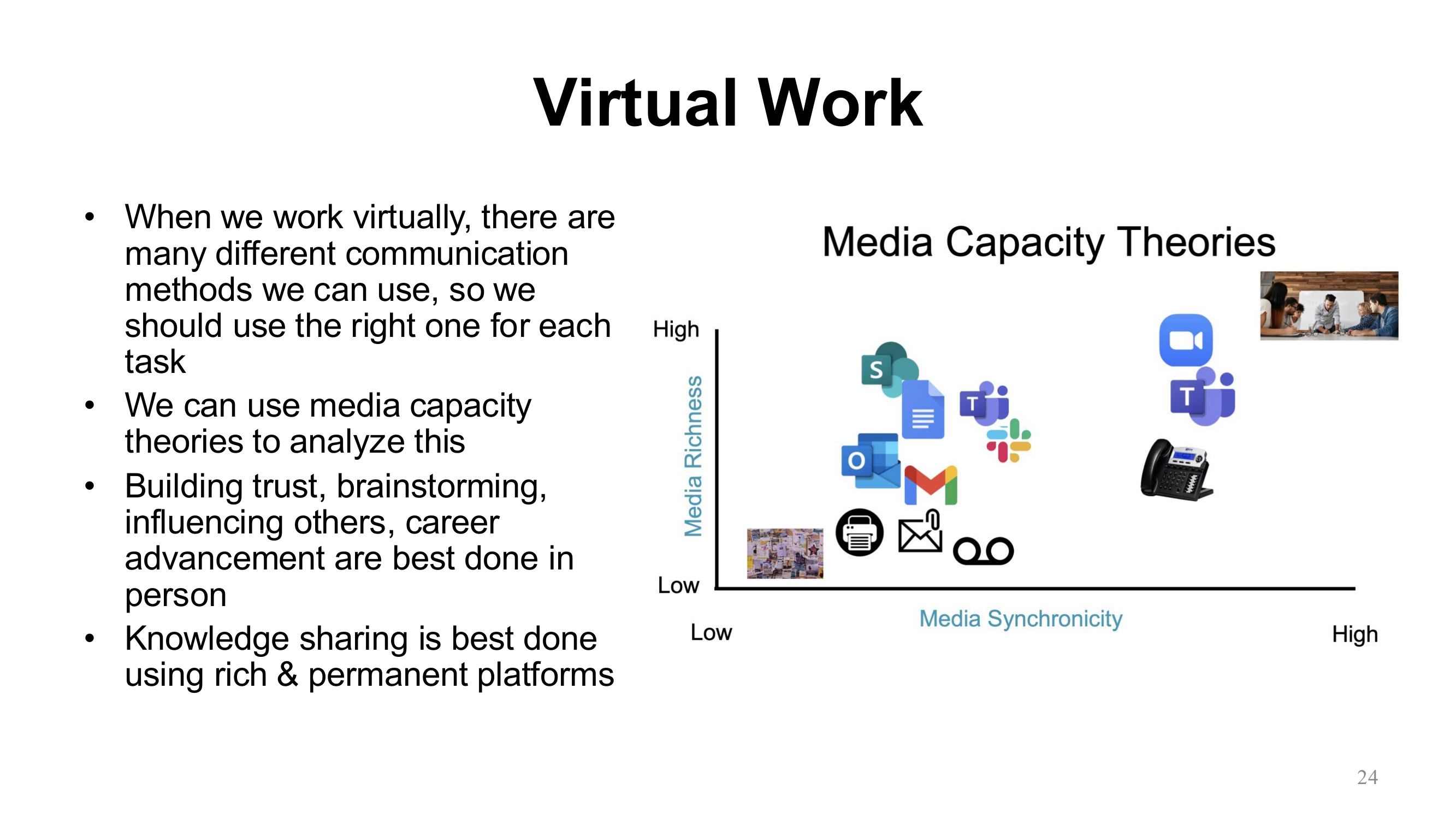
The shift to virtual and hybrid work has forced organizations to rethink communication, collaboration, and management. Two competing theories about media selection -- Media Richness Theory and Media Synchronicity Theory -- provide frameworks for choosing the right communication channel for the right task.
Media Capacity Theories
Media varies in "richness" (ability to convey multiple information cues, enable rapid feedback, and personalize messages). Match rich media to ambiguous/complex tasks, lean media to simple/routine tasks.
Focuses on whether tasks require convergence (agreeing on meaning -- needs synchronous media) or conveyance (transmitting information -- can use asynchronous media).
Matching Communication to Task
| Task / Activity | Best Medium | Why |
|---|---|---|
| Trust building | In person | Requires full range of social cues |
| Brainstorming | In person | Benefits from spontaneity, body language, energy |
| Influencing / Persuasion | In person | Emotional connection and real-time adaptation |
| Career advancement discussions | In person | Sensitivity, nuance, relationship-dependent |
| Knowledge sharing | Rich & permanent platforms | Needs to be both detailed and retrievable |
| Routine updates | Lean media (email, memo) | Simple, low ambiguity, asynchronous is fine |
AI & Work
Guest Lecture -- Chuma Asuzu
Artificial intelligence is reshaping organizational design. Understanding what current AI can and cannot do is essential for designing organizations that leverage AI effectively without over-relying on it. The future is human-AI collaboration, not replacement.
Current AI Landscape
AI today primarily means CNNs (Convolutional Neural Networks, for image/pattern recognition) and LLMs (Large Language Models, for text generation and reasoning). Generative AI is the current frontier.
- Knowledge synthesis -- combining information from many sources
- Task planning -- breaking complex work into steps
- Decision making support -- analyzing options with data
- Content generation -- drafting text, code, images
- Coding -- writing, debugging, and explaining code
- Novelty -- truly original, unprecedented ideas
- Hallucination -- confidently generating false information
- Safety-critical judgment -- lacking the expertise and intuition needed for high-stakes decisions
- Understanding context and nuance
- Emotional intelligence and empathy
The Key Principle: Use AI to improve work without impeding it. AI should augment human capabilities, not replace human judgment in areas where it is unreliable. The future is human-AI collaboration.
Ethics
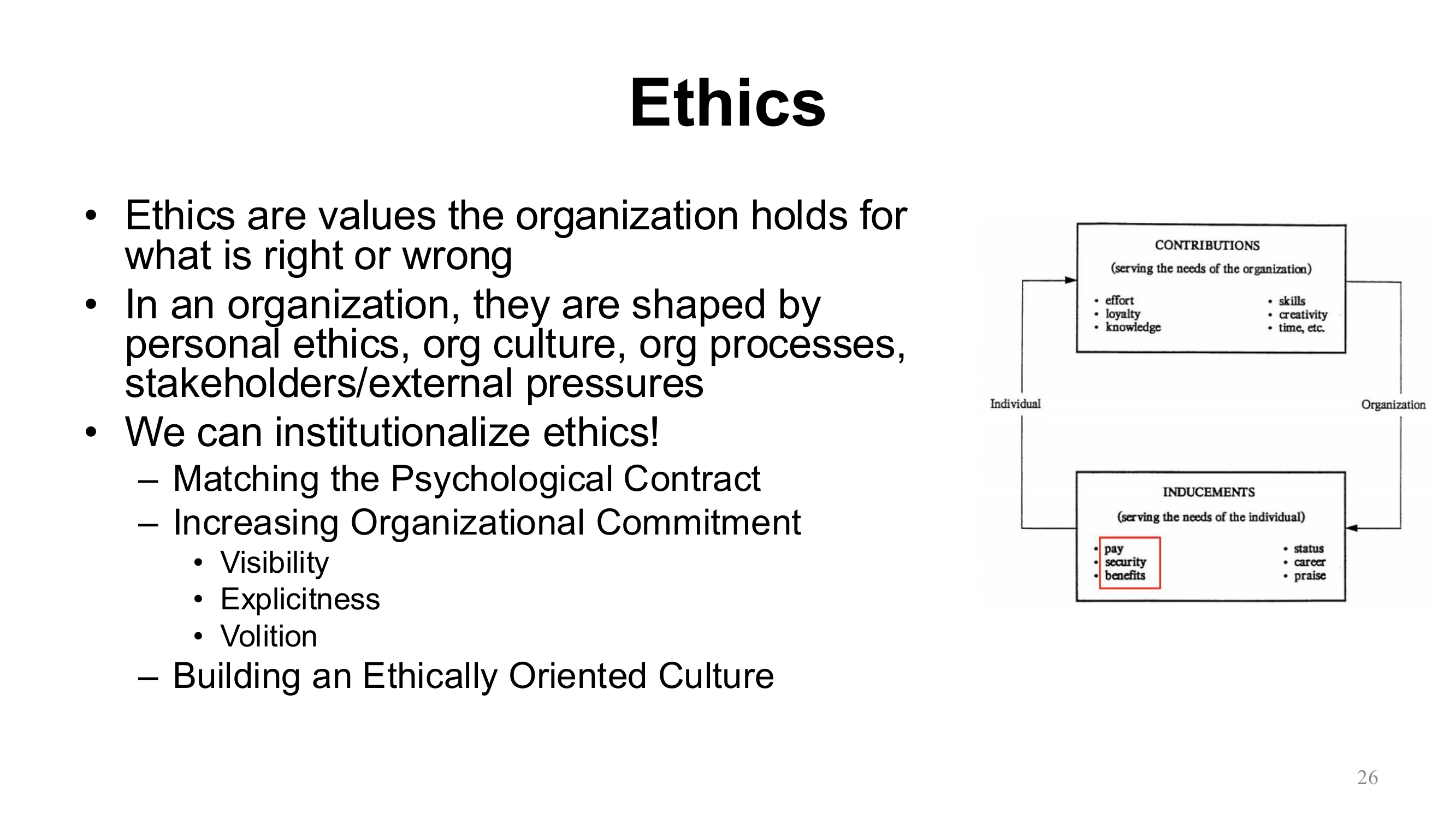
Ethics in organizational design is about the values an organization holds for distinguishing right from wrong. Ethics is not just about individual morality -- it is shaped by organizational culture, processes, and external pressures. The contributions-inducements model provides a framework for analyzing ethical obligations.
What Shapes Organizational Ethics
- Personal Ethics -- the moral values individuals bring to the organization
- Organizational Culture -- shared norms about what is acceptable behavior
- Organizational Processes -- rules, procedures, incentive systems, reporting structures
- Stakeholders & External Pressures -- regulators, customers, media, community expectations
Institutionalizing Ethics
Three approaches to making ethics structural, not just aspirational:
Ensure that what the organization promises (implicitly and explicitly) matches what employees actually experience. Breaches of the psychological contract erode trust and ethical behavior.
Three factors strengthen commitment: Visibility (actions are seen), Explicitness (expectations are clear), and Volition (people choose to commit rather than being forced).
Embedding ethics into the culture itself -- through stories, rituals, symbols, language, leadership modeling, and reward systems that celebrate ethical behavior.
Contributions-Inducements Model
Organizations and their members exist in an exchange relationship. Contributions are what members give (effort, time, skills, loyalty). Inducements are what the organization provides in return (pay, benefits, purpose, growth opportunities, social belonging). An ethical organization ensures this exchange is fair and transparent. When inducements fall short of contributions, members experience exploitation; when contributions fall short, the organization suffers free-riding.
Talent Management
The fundamental premise of talent management: treat employees well, they perform well, and the organization succeeds. This causal chain is not just aspirational -- it has structural implications for how organizations design jobs, compensation, and support systems.
The Psychological Contract
An unwritten set of mutual expectations between employee and employer. Unlike a legal contract, the psychological contract includes implicit promises about growth, fairness, autonomy, and purpose.
- Goal: Maximize matches between employee expectations and organizational delivery
- Breaches lead to: Quiet quitting (withdrawal of discretionary effort), burnout, turnover
- Breaches are more damaging than unmet explicit promises because they feel like betrayal
Beyond Pay
Compensation is necessary but not sufficient. Organizations that compete solely on pay enter a race to the bottom. Sustainable talent management includes:
- Healthcare and wellness programs -- physical, mental, financial health support
- Firm-specific benefits -- unique perks tied to the organization's identity that competitors cannot easily copy (a source of competitive advantage)
- Career development pathways
- Meaningful work and purpose alignment
- Work-life integration support
Org structure implications for pay: Organizational structure directly shapes compensation design. Flat organizations may use broad pay bands and team-based incentives. Tall hierarchies typically use narrow pay grades tied to level. Matrix structures need to address dual-reporting compensation fairly.
Structuring Collaboration
One of the most practical topics in the course: organizations waste enormous resources on poorly structured collaboration, particularly meetings. The problem is not collaboration itself but how it is designed. This section provides actionable diagnosis and fixes.
The Problem with Meetings
Most organizations suffer from five meeting pathologies:
- Too many meetings -- more time in meetings than doing work
- Too recurring -- meetings happen out of habit, not necessity
- Too many people -- inviting extras "just in case" wastes everyone's time
- Too long -- meetings expand to fill allocated time
- Wrong purpose -- using meetings for tasks better handled asynchronously
Fixes
- Only meet when needed -- the meeting should require synchronous interaction AND input from everyone present. If not, use async communication.
- Only invite necessary people -- each person should have a clear reason to attend. Send notes to others.
- Minimum time -- start with the shortest possible meeting length. Default to 25 or 50 minutes, not 30 or 60.
- Have an agenda -- circulate it in advance. Every meeting needs a clear purpose and expected outcomes.
- Stay on topic -- the facilitator's job is to prevent scope creep. Park off-topic items for later.
- Review necessity -- regularly audit recurring meetings. Cancel any that no longer serve their purpose.
International Business
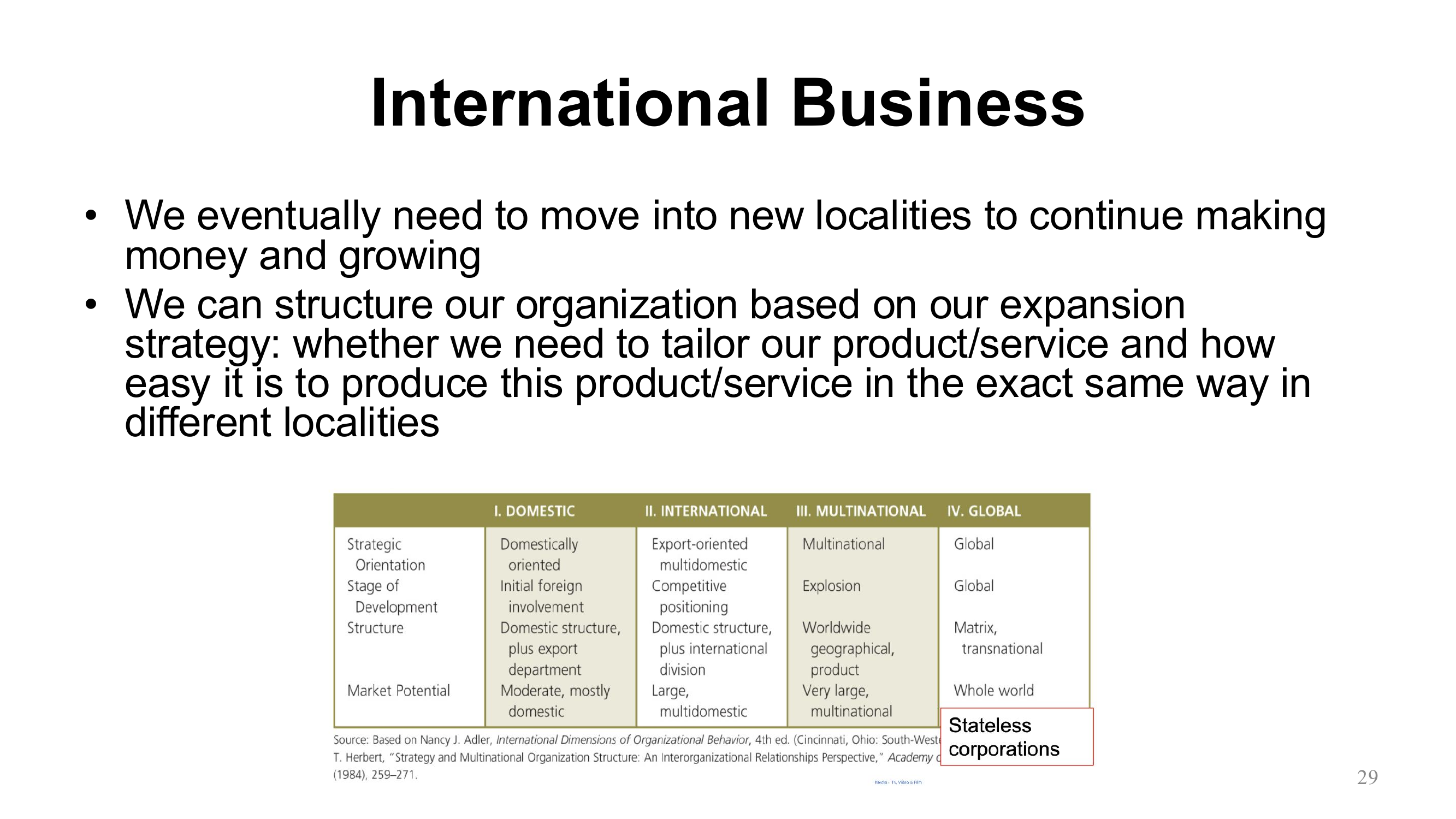
As organizations expand across borders, their structure must evolve. The four stages of international development provide a roadmap, and Hofstede's cultural dimensions offer a diagnostic framework for understanding how national culture shapes organizational design choices.
Four Stages of International Development
| Stage | Description | Structure |
|---|---|---|
| 1. Domestic | Operates within one country only | Standard functional or divisional structure |
| 2. International | Begins exporting, establishing foreign sales offices | International division added to domestic structure |
| 3. Multinational | Operations in many countries, adapts to local markets | Geographic divisions, decentralized, local adaptation |
| 4. Global | Operates as a single worldwide entity, transcends borders | Matrix or transnational structure, global integration |
Structure follows expansion strategy -- as the scope of international operations grows, structure must become more complex and integrated.
Hofstede's 6-D Cultural Model
Before expanding internationally, organizations must analyze the target culture. Hofstede's six dimensions provide a standardized comparison framework:
| Dimension | Description | High Score Means |
|---|---|---|
| Power Distance | Acceptance of unequal power distribution | Hierarchical, top-down, deference to authority |
| Individualism | Individual vs. collective identity | Self-reliant, individual achievement valued |
| Masculinity | Achievement/assertiveness vs. care/quality of life | Competitive, achievement-oriented |
| Uncertainty Avoidance | Tolerance for ambiguity and unknown | Rigid rules, formal procedures, low risk tolerance |
| Long-Term Orientation | Focus on future vs. present/past | Thrift, persistence, adaptation |
| Indulgence | Gratification of desires vs. restraint | Leisure, fun, personal freedom valued |
Analyze culture before expanding. Structural decisions that work in one national culture may fail catastrophically in another. For example, a flat, decentralized structure may not work in a high power distance culture where employees expect clear hierarchy.
Practice Exam
13 Questions / 55 Points Total / 2.5 Hours
Match the format of the actual exam: 4 questions have multi-parts, 1 longer response question. Click "Show Answer" to reveal model answers.
Amazon Ethics Scenario.
Part A (3 pts): During COVID-19, Amazon warehouse workers faced increased health risks while the company experienced record profits. Using the contributions-inducements model, explain the ethical implications of Amazon's response.
Part B (3 pts): Suggest four specific improvements Amazon could make from an organizational ethics perspective to address these concerns.
Part A -- Contributions-Inducements Analysis:
Contributions from workers: Physical labour in warehouses, health risks (exposure to COVID), long hours, fast-paced quotas, physical strain. During COVID, their contributions increased dramatically -- they were now risking their health and safety.
Inducements from Amazon: Wages (often minimum or near-minimum), basic benefits, temporary hazard pay (later removed). While the company's profits soared, the inducements did not proportionally increase to match the elevated contributions.
Ethical implication: The contributions-inducements balance shifted significantly against workers. They were contributing more (risk, effort) while inducements remained roughly the same or decreased (removal of hazard pay). This represents an exploitative imbalance -- the organization extracted disproportionate value from its most vulnerable members during a crisis. This breaches the psychological contract and violates principles of fair exchange.
Part B -- Four Improvements:
- Matching Psychological Contract: Maintain hazard pay for the duration of elevated risk, not just for PR purposes. Make explicit promises about safety investments and follow through consistently.
- Building Ethically Oriented Culture: Create worker safety committees with real authority, embed worker well-being into performance metrics for warehouse managers (not just throughput).
- Increasing Organizational Commitment through Visibility: Publish transparent data on worker injury rates, COVID cases, and safety investments. Make leadership accountable to visible metrics.
- Strengthening Stakeholder Responsiveness: Establish formal channels for workers to raise safety concerns without fear of retaliation (whistleblower protections), and include worker representatives in pandemic response planning.
Media Capacity Theories.
Part A (2 pts): A manager needs to communicate a routine policy update about expense reporting procedures. Identify what media should be used and justify using media capacity theories.
Part B (2 pts): The same manager needs to communicate a major organizational restructuring that will affect reporting lines and team composition. Identify what media should be used and justify.
Part A -- Routine Policy Update:
Medium: Email or written memo (lean media). According to Media Richness Theory, routine, unambiguous tasks should use lean media. An expense policy update is low in equivocality -- the message is straightforward and unlikely to be misinterpreted. A written format also provides a permanent reference document employees can consult later. From a Media Synchronicity perspective, this is a conveyance task (transmitting information), which is best served by asynchronous, reviewable media.
Part B -- Major Organizational Restructuring:
Medium: In-person meeting or town hall (rich media), followed by written documentation. A restructuring is highly ambiguous and emotionally charged -- people will have questions, fears, and need to process complex information. Media Richness Theory says high-ambiguity tasks require rich media that supports multiple cues (body language, tone), rapid feedback (Q&A), and personal presence (demonstrating leadership commitment). From a Media Synchronicity perspective, this is a convergence task -- people need to reach shared understanding of what the change means for them, which requires synchronous, real-time interaction. Follow up with written documentation for permanent reference.
How might AI tools change the design of an organization in terms of: (a) roles and job design, (b) decision making, and (c) communication patterns? Provide specific examples.
(a) Roles and Job Design: AI automates routine cognitive tasks (data entry, report generation, scheduling), which changes the division of labour. Roles shift from executing routine tasks to supervising AI outputs and handling exceptions. For example, a financial analyst's role shifts from building spreadsheets to validating AI-generated models and interpreting results. This means fewer specialists doing routine work and more generalists who can work across domains with AI support.
(b) Decision Making: AI enables more decentralized decision making because it can provide frontline workers with data-driven insights that previously required senior analysts. A store manager can use AI forecasting tools to make inventory decisions that previously required regional supply chain specialists. However, this also raises the question of who is accountable when AI-assisted decisions go wrong, requiring clearer governance structures.
(c) Communication Patterns: AI tools (chatbots, automated summaries, translation tools) can reduce the need for some coordination meetings. Knowledge that was previously shared through meetings can be captured and distributed by AI. This may flatten communication hierarchies -- information no longer needs to flow through managers as intermediaries. However, trust-building, brainstorming, and sensitive conversations still require human-to-human interaction, as AI lacks the emotional intelligence for these tasks.
Why are weak ties in a network associated with novel ideas and radical change, while strong ties support incremental change?
Weak ties connect individuals across different social groups and clusters. Because these connections bridge otherwise disconnected networks, they provide access to non-redundant information -- ideas, perspectives, and knowledge that the individual would not encounter within their own close-knit group. This diversity of input is the raw material for radical innovation and transformative change. Granovetter's "strength of weak ties" theory explains this.
Strong ties exist within dense, cohesive networks where people know each other well, share norms, and have high trust. This trust and shared understanding makes it easy to coordinate incremental improvements -- everyone is aligned, communication is efficient, and there is social pressure to follow through. However, the information circulating in cohesive networks tends to be redundant (everyone knows the same things), which limits the potential for breakthrough ideas. Strong ties are excellent for reliable execution but poor for radical innovation.
Part A (2 pts): Company X is a product-based company manufacturing home appliances. Describe how its organizational structure might be designed, referencing relevant design variables.
Part B (2 pts): Company Y is a service-based financial advisory firm. How might its structure differ from Company X, and why?
Part A -- Company X (Product, Appliances):
Division of Labour: High specialization -- assembly line workers perform specific, repetitive tasks. Engineers, quality control, and logistics are separate specialized functions. Collaboration: Primarily standardization of work processes (SOPs, quality checklists) and standardization of outputs (product specs). Shape: Moderately tall with clear hierarchy from floor workers to shift supervisors to plant managers to executives. Decision Making: Relatively centralized -- product design and strategy decided at HQ, production follows standardized procedures. Grouping: Likely divisional by product line (refrigerators division, washing machines division) or functional (manufacturing, marketing, R&D).
Part B -- Company Y (Service, Financial Advisory):
Division of Labour: Lower specialization -- advisors are generalists who handle entire client relationships across multiple financial products. Collaboration: Standardization of skills (professional certifications like CFA, CFP) and mutual adjustment (advisors consult each other on complex cases). Shape: Flatter -- fewer management layers, partners oversee associates. Decision Making: Decentralized -- advisors have significant autonomy to tailor recommendations to individual client needs. Centralization would undermine the personalized service model. Grouping: Could be by client segment (high net worth, retail, institutional) or geographic region. Service organizations need to be closer to their customers, so the structure is designed around the client rather than the production process.
Identify and explain three of Kotter's most critical reasons why change management efforts fail. For each, provide a brief example.
1. Not Establishing a Great Enough Sense of Urgency: If employees do not understand why the change is necessary, they will prioritize the status quo. Example: A company tries to digitize its supply chain but fails to communicate that competitors have already done so and are winning market share. Without urgency, middle managers keep using legacy systems.
2. Undercommunicating the Vision by a Factor of Ten: Leaders often announce a change once and assume everyone understands. In reality, the vision must be repeated through every channel -- emails, town halls, one-on-ones, visual reminders -- constantly. Example: A hospital announces a patient-safety initiative at one all-hands meeting, then wonders why nurses have not changed their procedures six months later.
3. Declaring Victory Too Soon: After achieving initial wins, leaders may celebrate prematurely and reduce effort. This allows old habits to creep back. Example: A company implements a new CRM system, sees initial adoption, and declares the project complete. Without continued support and reinforcement, employees revert to spreadsheets within a year.
A startup has grown from 10 employees to 200 in three years. Using the Organization Life Cycle model, answer: (a) What stage are they likely in? (b) What crisis are they facing? (c) What structural changes should they implement?
(a) Stage: The company is transitioning from the Collectivity stage to the Formalization stage. At 200 employees, the informal communication and founder-driven leadership that characterized the early stages is no longer sustainable. The company has likely outgrown the ability of its leaders to personally oversee everything.
(b) Crisis: They are facing the need for delegation with control. The founders/leaders are overwhelmed trying to manage everything directly. Lower-level managers want more autonomy, but leaders are reluctant to give up control without systems to ensure consistency and accountability.
(c) Structural Changes: The company should implement: (1) Formal rules and procedures -- SOPs, handbooks, onboarding processes to replace informal tribal knowledge. (2) Clear hierarchy and reporting structures -- define middle management roles with decision-making authority and accountability. (3) Specialization -- create dedicated departments (HR, Finance, Operations) rather than having everyone do everything. (4) Standardized coordination mechanisms -- move from mutual adjustment (which does not scale) to standardization of processes and outputs. (5) Performance measurement systems -- formal metrics so leaders can delegate with confidence that they can monitor results.
Compare and contrast the Prospector and Defender strategies from Miles & Snow's framework. Give an example company for each.
Prospector: Seeks new market opportunities, values innovation and first-mover advantage. Willing to take risks, operates in dynamic environments, constantly scanning for new products/markets. Structure is organic, flexible, decentralized with low formalization. R&D is a core investment. Example: Tesla -- constantly pushing into new markets (electric vehicles, energy storage, solar, autonomous driving), accepting risk and disruption.
Defender: Focuses on protecting current market share, emphasizes efficiency and cost control. Operates in stable environments, deepens expertise in a narrow domain. Structure is mechanistic, centralized, highly formalized with tight cost controls. Example: Walmart -- does not invent new product categories but relentlessly optimizes its supply chain and cost structure to defend its low-price leadership.
Key contrasts: Prospectors prioritize effectiveness (doing the right new things) while Defenders prioritize efficiency (doing current things right). Prospectors accept higher costs for growth potential; Defenders minimize costs to protect margins. Prospectors decentralize to enable speed; Defenders centralize to enable control. Both can be successful -- the key is internal consistency between strategy and structure.
A Canadian technology company (200 employees, flat structure, highly collaborative culture, emphasis on individual initiative) is expanding to Japan. Using Hofstede's 6-D cultural model and the international business stages framework, analyze what organizational design changes they should make. Address at least four of Hofstede's dimensions and explain the structural implications of each.
International Stage Analysis: Moving from domestic to international stage requires adding an international division or Japan-specific unit. As the Japan operations mature, they may progress toward a multinational structure with significant local adaptation.
Hofstede Dimension Analysis -- Canada vs. Japan:
1. Power Distance (Canada: Low, Japan: Moderate-High): Canada's flat, egalitarian structure will not directly translate. Japanese employees expect clearer hierarchy and deference to authority. The Japan office should have more defined reporting relationships and titles. Senior leaders should be visibly involved in decisions. Structural implication: add more management layers in the Japan office than the Canadian HQ.
2. Individualism (Canada: High, Japan: Moderate-Low / Collectivist): Canada's emphasis on individual initiative may alienate Japanese employees who value group harmony (wa) and consensus. Decision making in Japan should be more group-based (e.g., the ringi system of consensus building). Performance evaluation should include team-based metrics, not just individual KPIs. Structural implication: implement team-based work design and group decision-making processes.
3. Uncertainty Avoidance (Canada: Low, Japan: Very High): Japanese employees have low tolerance for ambiguity and prefer clear rules and procedures. The Canadian startup culture of "figure it out" will create anxiety. The Japan office needs more formalized processes, detailed documentation, and clearer role definitions. Structural implication: higher formalization, detailed SOPs, and clearer job descriptions than the Canadian office.
4. Long-Term Orientation (Canada: Low-Moderate, Japan: Very High): Japan values persistence, long-term planning, and building relationships over time. Quick wins and short-term metrics may not motivate the Japanese team. The company should set longer planning horizons and invest in relationship building with local partners. Structural implication: longer performance review cycles, investment in employee development, patience with market entry timeline.
5. Masculinity (Canada: Moderate, Japan: Very High): Japan is one of the most "masculine" cultures -- highly competitive, achievement-oriented, with distinct gender role expectations. The company should be aware of these dynamics in its HR practices and may need to work harder to create inclusive environments. Structural implication: competitive compensation structures, clear advancement paths, attention to work-life balance policies that may conflict with local norms.
Overall Recommendation: The company should not simply replicate its Canadian structure in Japan. It needs a hybrid approach: maintain the innovative, collaborative spirit that drives its success, but adapt the structural elements (hierarchy, formalization, decision-making processes) to align with Japanese cultural expectations. This may mean the Japan office looks structurally different from HQ -- and that is the right design choice.
Part A (2 pts): Explain the difference between positional power and personal power.
Part B (2 pts): For someone with low positional power (e.g., a junior employee), which influence strategy would be most effective and why?
Part A: Positional power derives from one's formal role and structural position within the organization -- centrality in information flows, visibility to leadership, flexibility in how the role is performed, and relevance of the role to organizational priorities. It exists because of the position, not the person; if someone leaves the role, the power stays with the position. Personal power derives from individual attributes -- expertise, personal attractiveness/charisma, demonstrated effort, and legitimacy (alignment with organizational values). It travels with the person regardless of their formal position.
Part B: A junior employee with low positional power should primarily rely on the Reason strategy, specifically the indirect form of appealing to values combined with the direct form of presenting facts.
Why: (1) Retribution is unavailable -- a junior employee lacks the formal authority to threaten or impose consequences. Attempting it would backfire. (2) Reciprocity is limited -- a junior employee has fewer resources to exchange and less ability to create meaningful obligations. (3) Reason is the most accessible because it relies on the quality of the argument, not the power of the person making it. A junior employee can build expertise (personal power), present well-researched proposals, and frame arguments in terms of organizational values and goals. This approach also builds credibility over time, increasing personal power for future influence.
Define psychological safety (1 pt) and explain two specific ways an organization can foster it (2 pts).
Definition: Psychological safety is a shared belief held by members of a team that the team is safe for interpersonal risk-taking. Team members feel confident that they will not be punished, humiliated, or rejected for speaking up with ideas, questions, concerns, or admitting mistakes.
Way 1 -- Leadership Modeling: Leaders can foster psychological safety by demonstrating vulnerability themselves -- admitting their own mistakes, asking questions publicly, and responding positively (not punitively) when team members raise concerns or dissent. When leaders model that it is safe to be imperfect, others follow. This can be institutionalized through regular "lessons learned" sessions where failures are discussed openly without blame.
Way 2 -- Structural Norms and Processes: Organizations can build psychological safety into their processes by implementing anonymous feedback channels, establishing "no-blame" incident review procedures (similar to aviation's approach to near-misses), and creating explicit norms in meetings (e.g., "all ideas are valid in brainstorming," rotating who speaks first to prevent senior members from anchoring discussion). These structural mechanisms ensure psychological safety does not depend solely on individual managers.
Using the four schools of thought for interorganizational relationships, classify the relationship between: (a) Uber and Lyft (1.5 pts), (b) Apple and Samsung (1.5 pts). Justify each classification.
(a) Uber and Lyft -- Population Ecology: These are similar organizations (both ride-sharing platforms with nearly identical business models) in a competitive relationship. Population Ecology examines how similar organizations compete for the same resources (riders, drivers, market share) and how environmental selection determines which survives. The framework predicts that the environment will select for the organization with the best "fit" -- in this case, the platform with the best network effects, pricing, and driver supply. Just as in biological ecosystems, two very similar species competing for the same niche will struggle to coexist indefinitely.
(b) Apple and Samsung -- Both Resource Dependence AND Population Ecology (dual classification): This relationship is complex. As competitors in smartphones, they are similar organizations in a competitive relationship (Population Ecology). However, Samsung also manufactures components (displays, chips) that Apple purchases, making them dissimilar organizations in a competitive-but-interdependent relationship (Resource Dependence). Apple depends on Samsung for critical components, and Samsung depends on Apple as a major customer. Each tries to minimize this dependence -- Apple by developing its own chips, Samsung by building its own phone brand. This dual classification reflects the real-world complexity that the 2x2 matrix simplifies.
Explain the difference between goal conflict and goal displacement with an example for each.
Goal Conflict: Occurs when pursuing one organizational goal makes it harder to achieve another. The goals themselves are legitimate but pull in different directions. Example: A hospital has goals of (1) minimizing costs and (2) providing the highest quality patient care. Pursuing aggressive cost cuts (cheaper supplies, fewer staff) directly undermines care quality. The two goals conflict, and the organization must find a balance rather than maximizing both simultaneously.
Goal Displacement: Occurs when the means to achieve a goal becomes the goal itself, displacing the original objective. The original goal gets lost as people focus on the process or metric rather than the underlying purpose. Example: A university sets a goal of improving teaching quality and implements student evaluation surveys as a measurement tool. Over time, professors focus on getting high survey scores (being entertaining, giving easy grades) rather than on actual teaching effectiveness. The survey -- originally a means -- has displaced the original goal of quality education.
Exam Scoring Reminder: The practice exam above totals 55 points across 13 questions to match the real exam format. Remember: less than 3 minutes per point. Write concisely. If asked for ONE answer, give only ONE -- they mark only the first. Circle or highlight your preferred answer when multiple are possible.
Study Checklist
Check off each topic as you review it. Progress is saved in your browser.
MIE 359 -- Organization Design -- Winter 2026
University of Toronto -- Final Exam Review Guide
Good luck on April 10.